OMGZOR! Heat Wave!!!

Amusingly, temperatures in Colorado (home of the National Weather Service Forecast Office) for the past few days have been higher than average, but all those people who were decrying global warming during the snowstorms this winter aren’t piping up about the above average heat.

It seems their lack of understanding about global warming only goes in one direction.

Satire is a beautiful thing

Amazingly enough, there are still people who claim to understand the science behind global warming, yet make the mistake of thinking localized cold temperatures, such as the recent snowstorms in the Eastern United States, are somehow a refutation of global warming. It’s almost as if they don’t understand the meaning of the key word “global.”

Jon Stewart captures it (and mocks it) perfectly in this Daily Show clip.

The Daily Show With Jon Stewart Mon – Thurs 11p / 10c
Unusually Large Snowstorm
www.thedailyshow.com

That bit makes fun of the “local versus global” aspect of global warming denialism and it is amusing, but at its heart is a serious issue… the denialist combination of ignorance and arrogance fueled by political and/or religious ideology. It’s a combination that inspires deniers to manufacture evidence, take evidence out of context, twist and distort evidence, and cherry pick evidence in their attempts to bolster their cause.

What makes it worse is that the denialist propaganda seems to be having its intended effect. Despite overwhelming evidence showing that our planet is warming faster than what natural cycles would indicate and that the warming is strongly affected by human activity, fewer and fewer people accept the science. What makes the denialist position so successful? Is it because their “evidence” is valid? …because their position is somehow warranted? Or is it, perhaps, that climate science is complicated… and therefore boring to a lot of people? Could it be that it takes too much effort to research the basics in order to gain a modicum of understanding of the science? …that real science is hard?

Here’s a hint. It’s not because denialist “evidence” is valid (and yes, the scare quotes are warranted).

Certainly, it’s far, far easier to look out the window at an above-average snowfall and conclude that no warming is occurring… and if that nicely-boxed conclusion is spruced up by your strongly-held ideology or by a level of (perhaps understandable) apathy that makes you susceptible to the loud voices of denialism, then it’s fairly easy to consider the matter closed and ignore any further evidence to the contrary.

That’s the scary result of politics trying to invalidate science… or religion trying to invalidate science. People get bad information and then they get the idea that there’s a controversy (where none should exist), or they start to think that scientists are full of crap, or that a biologist is the same as an astrophysicist (ie… a scientist is a scientist is a scientist), or that politicians have some sort of special “in” when it comes to the truth. People start to think that the scientific process is broken, or that a single mistake invalidates years (or even decades) of research, or that a scientist in a bitchy mood indicates that scientists are corrupt, or that scientists should be automatons who never get cranky when quote-mined by some junk-science-peddling politician.

The denialists’ position against global warming science is political, pure and simple. It can be summarized by the idea that, because the fix would be a hassle (or expensive), they want nothing to do with it. On that foundation is built their structure of misinformation… with twists, distortions, and lies… that only continues to stand because they yell loudly, they yell repeatedly, and they yell authoritatively. They do it with a self-righteous arrogance, implying that anyone who disagrees is not only wrong, but unpatriotic and stupid… perhaps socialist, too. They set up towering straw men to burn to the ground with their trite arguments, paying no mind to whether the argument is scientifically valid.

Despite all the denialists’ blustering, the thing they lack is truth. Perhaps truth isn’t important to them as long as they get their way, but truth is the intended destination of science.

The scientific process is self-correcting. Mistakes are sometimes made, but through the process, those mistakes are found and corrected. Science moves on, leaving behind an understanding of our world that is just a little bit better than before. That’s what science does. It moves. It progresses. It refuses to settle. It refuses to stop.

…and all the denialist blustering in the world won’t keep it from moving ahead.

Those stupid scientists!

Calamities of Nature - Hot Debate From Calamities of Nature comes this comic (the image here is just the first panel). I don’t want to spoil it for you, but I’ve heard a similar argument made by Sam Harris concerning the word “elite” in a Newsweek essay about Sarah Palin and politics last year. Not exactly the same argument, but related.

The comic brings up a valid point (though highly simplified to fit into three panels) and I’ve commented on it before… with no small amount of disdain. The point is relevant to more than the topic addressed and I’ve encountered the same seeming inconsistency-of-thought regarding evolution, the age of the Earth, cosmology, and a few other science-related topics.

It’s an attitude that science is great… unless it conflicts with your political or religious ideology… that it’s better, in that case, to trust someone who’s not too educated, not too intelligent, not too well informed, not too “elite”… rather than someone who is highly trained in the related field.

Here’s the excerpt from Sam Harris’s article (to save you the time of searching the Newsweek article for it):

Ask yourself: how has “elitism” become a bad word in American politics? There is simply no other walk of life in which extraordinary talent and rigorous training are denigrated. We want elite pilots to fly our planes, elite troops to undertake our most critical missions, elite athletes to represent us in competition and elite scientists to devote the most productive years of their lives to curing our diseases. And yet, when it comes time to vest people with even greater responsibilities, we consider it a virtue to shun any and all standards of excellence. When it comes to choosing the people whose thoughts and actions will decide the fates of millions, then we suddenly want someone just like us, someone fit to have a beer with, someone down-to-earth—in fact, almost anyone, provided that he or she doesn’t seem too intelligent or well educated.

It’s a huge problem in this country today.

Climate Literacy Primer

Via The Intersection blog, Chris Mooney made me aware of a great brochure (pdf) from NOAA, the National Oceanic and Atmospheric Administration, that gives some basic climate science literacy information. It’s a great introduction to the multifaceted complexities of climate science, how climate works, how it’s measured, and how humans effect it.

It starts out with a great definition of a “climate-literate person.”

A climate-literate person:

  • understands the essential principles of Earth’s climate system
  • knows how to assess scientifically credible information about climate
  • communicates about climate and climate change in a meaningful way
  • is able to make informed and responsible decisions with regard to actions that may affect climate.

It continues with information about why climate science literacy matters (and why science literacy in general matters), how climate science is an ongoing process, and how we can know what is scientifically correct.

The main points explained in the brochure are the following:

CLIMATE LITERACY: The Essential Principles of Climate Science

  1. The Sun is the primary source of energy for Earths climate system.
  2. Climate is regulated by complex interactions among components of the Earth system.
  3. Life on Earth depends on, is shaped by, and affects climate.
  4. Climate varies over space and time through both natural and man-made processes.
  5. Our understanding of the climate system is improved through observations, theoretical studies, and modeling.
  6. Human activities are impacting the climate system.
  7. Climate change will have consequences for the Earth system and human lives.

There’s plenty of detail for each point given and the explanations are clear, giving a solid foundation for learning more about climate science and actually understanding the climate issues that are affecting (and will affect) our lives.

Chris Mooney wonders…

But anyway, it is interesting to contemplate whether climate “skeptics” take issue with any of these basics, or whether they are indeed “climate science literate” by this standard. For after all, the complicated data and “hockey stick” type issues that “skeptics” seem to seize upon don’t appear to have much to do with these basics; and yet these basics are all you need to know that global warming is a serious concern and that we stand to get fried.

(ed. …and by “skeptics” he means “deniers”… hence the sarcasm quotes)

I’ve heard and read plenty from deniers who plainly lack a basic understanding of the science and who enthusiastically ride the denier bandwagon regardless of where it leads… whether it’s something as silly as offering a big snowstorm in Montana as evidence against global warming, using a few out-of-context comments by some climate scientists to decry the state of scientific research, or claiming that a lone scientist with a new way of looking at data has overturned decades of climate research. The bandwagon in question is propelled by politically-created excrement.

Here’s one of my favorite parts from the brochure.

CLIMATE SCIENCE LITERACY IS A PART OF SCIENCE LITERACY.

“Science, mathematics, and technology have a profound impact on our individual lives and our culture. They play a role in almost all human endeavors, and they affect how we relate to one another and the world around us. . . . Science Literacy enables us to make sense of real-world phenomena, informs our personal and social decisions, and serves as a foundation for a lifetime of learning.”

From the American Association for the Advancement of Science, Atlas of Science Literacy, Volume 2, Project 2061.

The fruits of science are all around us, yet the state of science literacy in our country is horrifyingly low. Not only do we have people who don’t understand science or how it works, but we have the much more harmful group of people who think they understand how science works and who think they have an understanding of scientific issues, but are hopelessly lost in an ideological quagmire created by politics, religion, or other insidious cultural influences.

Climate science denialism is a perfect example of how anti-scientific ideology mucks with the real issues in ways that will create tangible consequences. It’s not just a matter of philosophical differences (you go your way and I’ll go mine). It’s a matter of the actual, physical consequences of promoting actions (or non-actions, as the case may be) that would lead to the degradation of our environment (you can’t go your way and I can’t go mine… since you borked it all up, thank you very much).

There is no “your way” and “my way” when it comes to the habitability of this planet. There’s simply an “our way” because just like the anti-intellectual, anti-science deniers, I’m stuck on this planet. It’s my home. It’s where I keep my stuff. It’s where all my friends and family live. It’s where my daughter lives and will continue to live after I’m gone.

The anti-science crowd puts lives at risk. They put our country at risk. They put our world at risk. Whether it’s the climate science deniers, anti-vaxxers, homeopathy pushers, or the myriad of other pseudo-scientific proponents, it all boils down to a lack of understanding of (or a deliberate rejection of) science.

…and that affects us all.

How is ClimateGate like Creationism?

The “ClimateGate” email “scandal” about climate change reminds me very much about the manufactured controversy about evolution and Charles Darwin. How so?

In the case of evolution, deniers will frequently make accusations that Darwin was racist, or misogynistic, or anti-Semitic as “evidence” that evolution by natural selection is unreliable (or untrue). Whether those claims about Darwin are true or not is debatable, but even if they were all true, it has zero effect on the validity of the theory of evolution by natural selection.

Scientific theories are based on facts, not the personalities of researchers.

With “ClimateGate,” deniers focus on a small number of cherry-picked, old emails from a few climate scientists, take them out of context, twist (or misunderstand) their meanings, point out some crankiness on the part of the scientists, and claim that they somehow debunk and discredit decades of climate research and mountains of evidence compiled and analyzed by hundreds (or thousands?) of other climate scientists.

It’s absurd thinking of the highest degree.

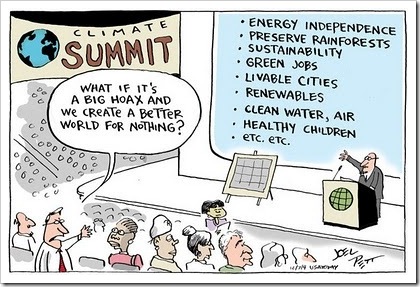
Copenhagen climate change conference

Copenhagen climate change conference: ‘Fourteen days to seal history’s judgment on this generation’

This Guardian editorial calling for action from world leaders on climate change is published today by 56 newspapers around the world in 20 languages. This editorial is free to reproduce under Creative Commons.

Today 56 newspapers in 45 countries take the unprecedented step of speaking with one voice through a common editorial. We do so because humanity faces a profound emergency.

Unless we combine to take decisive action, climate change will ravage our planet, and with it our prosperity and security. The dangers have been becoming apparent for a generation. Now the facts have started to speak: 11 of the past 14 years have been the warmest on record, the Arctic ice-cap is melting and last year’s inflamed oil and food prices provide a foretaste of future havoc. In scientific journals the question is no longer whether humans are to blame, but how little time we have got left to limit the damage. Yet so far the world’s response has been feeble and half-hearted.

Climate change has been caused over centuries, has consequences that will endure for all time and our prospects of taming it will be determined in the next 14 days. We call on the representatives of the 192 countries gathered in Copenhagen not to hesitate, not to fall into dispute, not to blame each other but to seize opportunity from the greatest modern failure of politics. This should not be a fight between the rich world and the poor world, or between east and west. Climate change affects everyone, and must be solved by everyone.

The science is complex but the facts are clear. The world needs to take steps to limit temperature rises to 2C, an aim that will require global emissions to peak and begin falling within the next 5-10 years. A bigger rise of 3-4C — the smallest increase we can prudently expect to follow inaction — would parch continents, turning farmland into desert. Half of all species could become extinct, untold millions of people would be displaced, whole nations drowned by the sea. The controversy over emails by British researchers that suggest they tried to suppress inconvenient data has muddied the waters but failed to dent the mass of evidence on which these predictions are based.

Few believe that Copenhagen can any longer produce a fully polished treaty; real progress towards one could only begin with the arrival of President Obama in the White House and the reversal of years of US obstructionism. Even now the world finds itself at the mercy of American domestic politics, for the president cannot fully commit to the action required until the US Congress has done so.

But the politicians in Copenhagen can and must agree the essential elements of a fair and effective deal and, crucially, a firm timetable for turning it into a treaty. Next June’s UN climate meeting in Bonn should be their deadline. As one negotiator put it: “We can go into extra time but we can’t afford a replay.”

At the deal’s heart must be a settlement between the rich world and the developing world covering how the burden of fighting climate change will be divided — and how we will share a newly precious resource: the trillion or so tonnes of carbon that we can emit before the mercury rises to dangerous levels.

Rich nations like to point to the arithmetic truth that there can be no solution until developing giants such as China take more radical steps than they have so far. But the rich world is responsible for most of the accumulated carbon in the atmosphere – three-quarters of all carbon dioxide emitted since 1850. It must now take a lead, and every developed country must commit to deep cuts which will reduce their emissions within a decade to very substantially less than their 1990 level.

Developing countries can point out they did not cause the bulk of the problem, and also that the poorest regions of the world will be hardest hit. But they will increasingly contribute to warming, and must thus pledge meaningful and quantifiable action of their own. Though both fell short of what some had hoped for, the recent commitments to emissions targets by the world’s biggest polluters, the United States and China, were important steps in the right direction.

Social justice demands that the industrialised world digs deep into its pockets and pledges cash to help poorer countries adapt to climate change, and clean technologies to enable them to grow economically without growing their emissions. The architecture of a future treaty must also be pinned down – with rigorous multilateral monitoring, fair rewards for protecting forests, and the credible assessment of “exported emissions” so that the burden can eventually be more equitably shared between those who produce polluting products and those who consume them. And fairness requires that the burden placed on individual developed countries should take into account their ability to bear it; for instance newer EU members, often much poorer than “old Europe”, must not suffer more than their richer partners.

The transformation will be costly, but many times less than the bill for bailing out global finance — and far less costly than the consequences of doing nothing.

Many of us, particularly in the developed world, will have to change our lifestyles. The era of flights that cost less than the taxi ride to the airport is drawing to a close. We will have to shop, eat and travel more intelligently. We will have to pay more for our energy, and use less of it.

But the shift to a low-carbon society holds out the prospect of more opportunity than sacrifice. Already some countries have recognized that embracing the transformation can bring growth, jobs and better quality lives. The flow of capital tells its own story: last year for the first time more was invested in renewable forms of energy than producing electricity from fossil fuels.

Kicking our carbon habit within a few short decades will require a feat of engineering and innovation to match anything in our history. But whereas putting a man on the moon or splitting the atom were born of conflict and competition, the coming carbon race must be driven by a collaborative effort to achieve collective salvation.

Overcoming climate change will take a triumph of optimism over pessimism, of vision over short-sightedness, of what Abraham Lincoln called “the better angels of our nature”.

It is in that spirit that 56 newspapers from around the world have united behind this editorial. If we, with such different national and political perspectives, can agree on what must be done then surely our leaders can too.

The politicians in Copenhagen have the power to shape history’s judgment on this generation: one that saw a challenge and rose to it, or one so stupid that we saw calamity coming but did nothing to avert it. We implore them to make the right choice.

(via)