Digital Chum - Virtual fish guts and other nonsense

global warming

The RNC’s "Purity" Resolutions

The Republican National Committee will be in Hawaii this week for its annual meeting to discuss its agenda. One of the items on the agenda is a series of ten statements dubbed the “purity” test by the media. The actual name is a mouthful: Resolution on Reagan’s Unity Principle for Support of Candidates. The idea is that Republican candidates must agree with at least eight of the ten statements in order to qualify for campaign contributions and/or an endorsement from the RNC.

It seems it was originally proposed in November of 2009, but wasn’t taken up for consideration. Reportedly, it will be this week.

I’ve read mixed reactions about the proposal. Some think it’s a good idea. Some think the Republicans are shooting themselves in the foot. Of course, the RNC can do what it wants, and though I can understand their desire to have a sort of litmus test for candidates, this seems somewhat draconian.

Here’s a link to the entire document (it’s a PDF), and below I have a list of each of the ten items along with my commentary on each one.

We support smaller government, smaller national debt, lower deficits and lower taxes by opposing bills like Obama’s “stimulus” bill;

I’m onboard with that… except for the wording. It seems silly to include the final clause “by opposing bills like Obama’s ‘stimulus’ bill.” Not only are the scare quotes overly dramatic and laden with unnecessary sarcasm, but wouldn’t it be more constructive to give a more positive suggestion about how to reach the goal?

We support market-based health care reform and oppose Obama-style government run healthcare;

Again with the unnecessary “Obama-style” word choice. Why not just “We support market-based health care reform?” I think a simple approach to health care reform would be a good choice, but of course there needs to be regulation. There is some good in the current healthcare proposal… no exclusions for pre-existing conditions, for example… but something leaner would be better. On the other hand, if the current proposal doesn’t pass, healthcare reform will be essentially dead for another few decades. I suppose I can say that I, too, support market-based health care reform, but it really depends on what is meant by “market-based health care reform.” There’s plenty more to say here, but I’ll just leave it at that, since the statement is so vague.

We support market-based energy reforms by opposing cap and trade legislation;

This statement is mostly meaningless in what it supports, but says more about what it opposes. Republicans are notorious for being climate change deniers, and it almost seems that their denial stems from their dislike for any solution that costs money. I don’t know what is meant by “market-based energy reforms” but gauging from what I hear from many Republicans, it means letting companies pollute all they want, drilling for more oil, burning more fossil fuels, and flipping the bird to the environment… and to science.

We support workers’ right to secret ballot by opposing card check;

Hooray! This is one that I support 100%!… and it’s strangely specific compared to most of the other statements. The union push to eliminate anonymous voting is basically giving them free rein to use precision bullying and intimidation tactics. They complain about corporate intimidation of employees, but the fact is that, with secret ballots, neither the company nor the union knows how any individual voted. That’s as it should be.

We support legal immigration and assimilation into American society by opposing amnesty for illegal immigrants;

I’m of mixed opinion here. I support legal immigration and assimilation into American society. The rest of the statement is a non sequitur in reference to the first part. You don’t support legal immigration by opposing amnesty. The two are related but not dependant. I’m undecided on the amnesty issue.

We support victory in Iraq and Afghanistan by supporting military-recommended troop surges;

“We support victory.” That’s meaningless tripe. Everyone supports victory. It’s not a question of whether someone supports victory or not. It’s a question of whether victory is even possible… which it probably isn’t in any meaningful way. Invading Afghanistan was understandable and (mostly) warranted. Invading Iraq was not. That aside, these people have been fighting amongst themselves for longer than our country has been in existence and suddenly we think we can resolve all their problems? Not gonna happen. Waste of money. Waste of time. Waste of human life.

We support containment of Iran and North Korea, particularly effective action to eliminate their nuclear weapons threat;

Yes. I support this as well, but the caveat is that it depends on what they mean by “effective action.” The recent Republican track record on this is less than stellar.

We support retention of the Defense of Marriage Act;

The Defense of Marriage Act is nothing but blatant rights-removing, religion-based bigotry and homophobia. No… I don’t support this statement in the least.

We support protecting the lives of vulnerable persons by opposing health care rationing and denial of health care and government funding of abortion;

This statement is laughable because our current system is all about rationing and denial of health care. Are they suggesting that everyone should have unlimited health care coverage? Isn’t that… *gasp!*… socialistic? As for government funding of abortion… I don’t care if it’s government funded or not as long as the right to have an abortion isn’t restricted. However, I do support protecting the lives of “vulnerable persons.”

We support the right to keep and bear arms by opposing government restrictions on gun ownership;

I’m okay with this statement, too, assuming it doesn’t mean that Average Joe and Frank the Felon can stock up their houses with automatic weapons and RPGs. The statement is vague on that point. I think existing regulations are fine for the most part… waiting periods and registrations are nothing insidious.

So, overall, the statements are a bit too vague to just accept unconditionally… and a few of them are vague to the point of meaninglessness… and at least one is reprehensible. It doesn’t seem to be a collection of statements on which the Republicans want to hang their future, but it will be interesting to see what they decide.

However, it looks like I would pass the test because I support at least eight of the statements. In most cases, my support is conditional, but given the vagueness of some of the statements, I think it’s only fair that I add the necessary detail on my own. But even though I’m not a Democrat, I don’t think I’ll be calling myself a Republican any time soon.

They still have a long way to go.

Those stupid scientists!

Calamities of Nature - Hot Debate From Calamities of Nature comes this comic (the image here is just the first panel). I don’t want to spoil it for you, but I’ve heard a similar argument made by Sam Harris concerning the word “elite” in a Newsweek essay about Sarah Palin and politics last year. Not exactly the same argument, but related.

The comic brings up a valid point (though highly simplified to fit into three panels) and I’ve commented on it before… with no small amount of disdain. The point is relevant to more than the topic addressed and I’ve encountered the same seeming inconsistency-of-thought regarding evolution, the age of the Earth, cosmology, and a few other science-related topics.

It’s an attitude that science is great… unless it conflicts with your political or religious ideology… that it’s better, in that case, to trust someone who’s not too educated, not too intelligent, not too well informed, not too “elite”… rather than someone who is highly trained in the related field.

Here’s the excerpt from Sam Harris’s article (to save you the time of searching the Newsweek article for it):

Ask yourself: how has “elitism” become a bad word in American politics? There is simply no other walk of life in which extraordinary talent and rigorous training are denigrated. We want elite pilots to fly our planes, elite troops to undertake our most critical missions, elite athletes to represent us in competition and elite scientists to devote the most productive years of their lives to curing our diseases. And yet, when it comes time to vest people with even greater responsibilities, we consider it a virtue to shun any and all standards of excellence. When it comes to choosing the people whose thoughts and actions will decide the fates of millions, then we suddenly want someone just like us, someone fit to have a beer with, someone down-to-earth—in fact, almost anyone, provided that he or she doesn’t seem too intelligent or well educated.

It’s a huge problem in this country today.

Climate Literacy Primer

Via The Intersection blog, Chris Mooney made me aware of a great brochure (pdf) from NOAA, the National Oceanic and Atmospheric Administration, that gives some basic climate science literacy information. It’s a great introduction to the multifaceted complexities of climate science, how climate works, how it’s measured, and how humans effect it.

It starts out with a great definition of a “climate-literate person.”

A climate-literate person:

  • understands the essential principles of Earth’s climate system
  • knows how to assess scientifically credible information about climate
  • communicates about climate and climate change in a meaningful way
  • is able to make informed and responsible decisions with regard to actions that may affect climate.

It continues with information about why climate science literacy matters (and why science literacy in general matters), how climate science is an ongoing process, and how we can know what is scientifically correct.

The main points explained in the brochure are the following:

CLIMATE LITERACY: The Essential Principles of Climate Science

  1. The Sun is the primary source of energy for Earths climate system.
  2. Climate is regulated by complex interactions among components of the Earth system.
  3. Life on Earth depends on, is shaped by, and affects climate.
  4. Climate varies over space and time through both natural and man-made processes.
  5. Our understanding of the climate system is improved through observations, theoretical studies, and modeling.
  6. Human activities are impacting the climate system.
  7. Climate change will have consequences for the Earth system and human lives.

There’s plenty of detail for each point given and the explanations are clear, giving a solid foundation for learning more about climate science and actually understanding the climate issues that are affecting (and will affect) our lives.

Chris Mooney wonders…

But anyway, it is interesting to contemplate whether climate “skeptics” take issue with any of these basics, or whether they are indeed “climate science literate” by this standard. For after all, the complicated data and “hockey stick” type issues that “skeptics” seem to seize upon don’t appear to have much to do with these basics; and yet these basics are all you need to know that global warming is a serious concern and that we stand to get fried.

(ed. …and by “skeptics” he means “deniers”… hence the sarcasm quotes)

I’ve heard and read plenty from deniers who plainly lack a basic understanding of the science and who enthusiastically ride the denier bandwagon regardless of where it leads… whether it’s something as silly as offering a big snowstorm in Montana as evidence against global warming, using a few out-of-context comments by some climate scientists to decry the state of scientific research, or claiming that a lone scientist with a new way of looking at data has overturned decades of climate research. The bandwagon in question is propelled by politically-created excrement.

Here’s one of my favorite parts from the brochure.

CLIMATE SCIENCE LITERACY IS A PART OF SCIENCE LITERACY.

“Science, mathematics, and technology have a profound impact on our individual lives and our culture. They play a role in almost all human endeavors, and they affect how we relate to one another and the world around us. . . . Science Literacy enables us to make sense of real-world phenomena, informs our personal and social decisions, and serves as a foundation for a lifetime of learning.”

From the American Association for the Advancement of Science, Atlas of Science Literacy, Volume 2, Project 2061.

The fruits of science are all around us, yet the state of science literacy in our country is horrifyingly low. Not only do we have people who don’t understand science or how it works, but we have the much more harmful group of people who think they understand how science works and who think they have an understanding of scientific issues, but are hopelessly lost in an ideological quagmire created by politics, religion, or other insidious cultural influences.

Climate science denialism is a perfect example of how anti-scientific ideology mucks with the real issues in ways that will create tangible consequences. It’s not just a matter of philosophical differences (you go your way and I’ll go mine). It’s a matter of the actual, physical consequences of promoting actions (or non-actions, as the case may be) that would lead to the degradation of our environment (you can’t go your way and I can’t go mine… since you borked it all up, thank you very much).

There is no “your way” and “my way” when it comes to the habitability of this planet. There’s simply an “our way” because just like the anti-intellectual, anti-science deniers, I’m stuck on this planet. It’s my home. It’s where I keep my stuff. It’s where all my friends and family live. It’s where my daughter lives and will continue to live after I’m gone.

The anti-science crowd puts lives at risk. They put our country at risk. They put our world at risk. Whether it’s the climate science deniers, anti-vaxxers, homeopathy pushers, or the myriad of other pseudo-scientific proponents, it all boils down to a lack of understanding of (or a deliberate rejection of) science.

…and that affects us all.

Oh, yes. I’ve heard this before.

Homer’s reaction pretty much sums up the climate change denialists’ behavior.

(via)

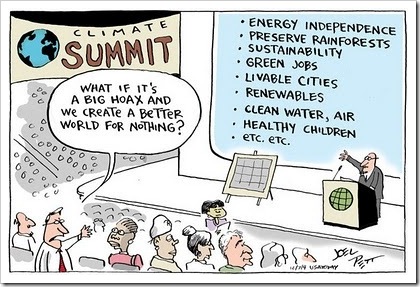
What if it’s a big hoax!?

As PZ Myers said, “Isn’t this what the global warming debate is actually all about?”

Climate Change Deniers - The Bottom Line

(via)

Who to believe?

“Who to believe on climate change mystery: scientists or conservative pundits?”

- Josh Marshall

It seems like the answer should be obvious.

(via)

Global Warming, Deniers, and "ClimateGate"

Great editorial by Chris Mooney on the Science Progress blog about global warming and the deniers’ campaign to discredit the real science that supports it.

(via)

Copenhagen climate change conference

Copenhagen climate change conference: ‘Fourteen days to seal history’s judgment on this generation’

This Guardian editorial calling for action from world leaders on climate change is published today by 56 newspapers around the world in 20 languages. This editorial is free to reproduce under Creative Commons.

Today 56 newspapers in 45 countries take the unprecedented step of speaking with one voice through a common editorial. We do so because humanity faces a profound emergency.

Unless we combine to take decisive action, climate change will ravage our planet, and with it our prosperity and security. The dangers have been becoming apparent for a generation. Now the facts have started to speak: 11 of the past 14 years have been the warmest on record, the Arctic ice-cap is melting and last year’s inflamed oil and food prices provide a foretaste of future havoc. In scientific journals the question is no longer whether humans are to blame, but how little time we have got left to limit the damage. Yet so far the world’s response has been feeble and half-hearted.

Climate change has been caused over centuries, has consequences that will endure for all time and our prospects of taming it will be determined in the next 14 days. We call on the representatives of the 192 countries gathered in Copenhagen not to hesitate, not to fall into dispute, not to blame each other but to seize opportunity from the greatest modern failure of politics. This should not be a fight between the rich world and the poor world, or between east and west. Climate change affects everyone, and must be solved by everyone.

The science is complex but the facts are clear. The world needs to take steps to limit temperature rises to 2C, an aim that will require global emissions to peak and begin falling within the next 5-10 years. A bigger rise of 3-4C — the smallest increase we can prudently expect to follow inaction — would parch continents, turning farmland into desert. Half of all species could become extinct, untold millions of people would be displaced, whole nations drowned by the sea. The controversy over emails by British researchers that suggest they tried to suppress inconvenient data has muddied the waters but failed to dent the mass of evidence on which these predictions are based.

Few believe that Copenhagen can any longer produce a fully polished treaty; real progress towards one could only begin with the arrival of President Obama in the White House and the reversal of years of US obstructionism. Even now the world finds itself at the mercy of American domestic politics, for the president cannot fully commit to the action required until the US Congress has done so.

But the politicians in Copenhagen can and must agree the essential elements of a fair and effective deal and, crucially, a firm timetable for turning it into a treaty. Next June’s UN climate meeting in Bonn should be their deadline. As one negotiator put it: “We can go into extra time but we can’t afford a replay.”

At the deal’s heart must be a settlement between the rich world and the developing world covering how the burden of fighting climate change will be divided — and how we will share a newly precious resource: the trillion or so tonnes of carbon that we can emit before the mercury rises to dangerous levels.

Rich nations like to point to the arithmetic truth that there can be no solution until developing giants such as China take more radical steps than they have so far. But the rich world is responsible for most of the accumulated carbon in the atmosphere – three-quarters of all carbon dioxide emitted since 1850. It must now take a lead, and every developed country must commit to deep cuts which will reduce their emissions within a decade to very substantially less than their 1990 level.

Developing countries can point out they did not cause the bulk of the problem, and also that the poorest regions of the world will be hardest hit. But they will increasingly contribute to warming, and must thus pledge meaningful and quantifiable action of their own. Though both fell short of what some had hoped for, the recent commitments to emissions targets by the world’s biggest polluters, the United States and China, were important steps in the right direction.

Social justice demands that the industrialised world digs deep into its pockets and pledges cash to help poorer countries adapt to climate change, and clean technologies to enable them to grow economically without growing their emissions. The architecture of a future treaty must also be pinned down – with rigorous multilateral monitoring, fair rewards for protecting forests, and the credible assessment of “exported emissions” so that the burden can eventually be more equitably shared between those who produce polluting products and those who consume them. And fairness requires that the burden placed on individual developed countries should take into account their ability to bear it; for instance newer EU members, often much poorer than “old Europe”, must not suffer more than their richer partners.

The transformation will be costly, but many times less than the bill for bailing out global finance — and far less costly than the consequences of doing nothing.

Many of us, particularly in the developed world, will have to change our lifestyles. The era of flights that cost less than the taxi ride to the airport is drawing to a close. We will have to shop, eat and travel more intelligently. We will have to pay more for our energy, and use less of it.

But the shift to a low-carbon society holds out the prospect of more opportunity than sacrifice. Already some countries have recognized that embracing the transformation can bring growth, jobs and better quality lives. The flow of capital tells its own story: last year for the first time more was invested in renewable forms of energy than producing electricity from fossil fuels.

Kicking our carbon habit within a few short decades will require a feat of engineering and innovation to match anything in our history. But whereas putting a man on the moon or splitting the atom were born of conflict and competition, the coming carbon race must be driven by a collaborative effort to achieve collective salvation.

Overcoming climate change will take a triumph of optimism over pessimism, of vision over short-sightedness, of what Abraham Lincoln called “the better angels of our nature”.

It is in that spirit that 56 newspapers from around the world have united behind this editorial. If we, with such different national and political perspectives, can agree on what must be done then surely our leaders can too.

The politicians in Copenhagen have the power to shape history’s judgment on this generation: one that saw a challenge and rose to it, or one so stupid that we saw calamity coming but did nothing to avert it. We implore them to make the right choice.

(via)

Phil Plait nails it… again.

Phil Plait over at Bad Astronomy is pretty science-minded (intentionally understated for dramatic effect). One of his latest posts deals with the email "scandal" at the CRU and as usual, Phil makes his point both decisively and eloquently. Here are a few choice bits, but the entire post is well worth reading.

On what the CRU scientists were doing…

What these files do show is scientists trying to deal with data, software, and science, all the while also trying to figure out what to do with attacks on their work that are largely ideologically driven. I don’t think they handled that all that well, and that doesn’t surprise me. They’re scientists, not wonks. Of course, if you look at the files from the point of view of giant conspiracies it seems very racy [...]

On the attitude of the CRU scientists…

As far as the scientists’ attitudes go, much hay has been made of that as well. But I wonder. Imagine you’ve dedicated your life to some scientific pursuit. You do it because you love it, because you want to make the world a better place, and because you can see the physics beneath the surface, weaving the tapestry of reality, guiding the ebb and flow of forces both subtle and gross. Then you find that people start attacking you with flimsy evidence, politically motivated vitriol, and even elected officials say that what you are doing is a "hoax". How do you react?

That’s one of my favorite points. Wanting to stop bad or faulty research from getting published in reputable science journals is not a bad thing. The climate change deniers generally have nothing valid or worthwhile (from a scientific standpoint) to publish.

On how science works…

Science is necessarily conservative. Once something is established as being an accepted model/theory/law, then it becomes the standard paradigm until it is shown to be flawed in a significant way. You may not like it, but in modern climatology, global warming is accepted as the standard. It’s not up to me or anyone to prove it right at this point, it’s up to scientists to show it’s wrong. To do that you’ll need a lot of really good evidence, and from what I have seen and read that evidence is not there. Maybe it’s fair to say not yet there, but in reality it may not be there at all.

On the term "denier" versus the term "skeptic"…

I’ll note that some people are still upset by my use of the term deniers. Again, to be clear: a skeptic is someone who uses evidence and logic to reach a conclusion. A denialist is someone who will say or do anything to deny an issue. I stand by my definition. There are actual global warming skeptics out there — and I would not only support their efforts but praise them — but what I see on the web and in the comments overwhelmingly is denial, not skepticism.

That’s what I usually see as well, though I do see some "skeptic" papers from time to time. Deniers, however, latch on to the irrelevant papers or the quote-mine papers or the artificial drama papers and hold them up as proof positive that climate change is a hoax or a scam. It’s somewhat pathetic and really shows a lack of understanding of science… how it works, and how it’s used.

But I suppose that’s to be expected from deniers.

Climate Change and CRU Emails

Instead of re-posting the entire entry here, I’m going to link to my Rationality Now post with my commentary about the CRU email hack and what, if any, implications the emails have on climate change research.

Right turn, Clyde… or not.

I’ve mentioned before that I wish the Republican party would “go back to being the fiscally conservative, small government party they used to be instead of the religious, anti-science, anti-intellectual, anti-environment party they are now.”

Andrew Sullivan, over at The Daily Dish,  seems to have the same idea, but in more detail. Andrew and I are not alone, either, since I’ve seen links to his post from two other blogs today, as well as a post by Charles Johnson at Little Green Footballs who also put together a list of why he’s parted ways with the Right. No doubt there are plenty more who agree with these folks.

Here’s a sampling of items from both posts that I find particularly noteworthy (though I recommend going through the full posts of both blog authors).

From Andrew Sullivan:

  • I cannot support a movement that holds torture as a core value.
  • I cannot support a movement that holds that purely religious doctrine should govern civil political decisions and that uses the sacredness of religious faith for the pursuit of worldly power.
  • I cannot support a movement that would back a vice-presidential candidate manifestly unqualified and duplicitous because of identity politics and electoral cynicism.
  • I cannot support a movement that does not accept evolution as a fact.
  • I cannot support a movement that sees climate change as a hoax and offers domestic oil exploration as the core plank of an energy policy
  • I cannot support a movement that refuses to distance itself from a demagogue like Rush Limbaugh or a nutjob like Glenn Beck.
  • I cannot support a movement that believes that the United States should be the sole global power, should sustain a permanent war machine to police the entire planet, and sees violence as the core tool for international relations.

From Charles Johnson (reasons why he parted ways with the Right):

  • Support for bigotry, hatred, and white supremacism (see: Pat Buchanan, Ann Coulter, Robert Stacy McCain, Lew Rockwell, etc.)
  • Support for throwing women back into the Dark Ages, and general religious fanaticism (see: Operation Rescue, anti-abortion groups, James Dobson, Pat Robertson, Tony Perkins, the entire religious right, etc.)
  • Support for anti-science bad craziness (see: creationism, climate change denialism, Sarah Palin, Michele Bachmann, James Inhofe, etc.)
  • Support for homophobic bigotry (see: Sarah Palin, Dobson, the entire religious right, etc.)
  • Support for anti-government lunacy (see: tea parties, militias, Fox News, Glenn Beck, etc.)
  • Support for conspiracy theories and hate speech (see: Alex Jones, Rush Limbaugh, Glenn Beck, Birthers, creationists, climate deniers, etc.)
  • A right-wing blogosphere that is almost universally dominated by raging hate speech (see: Hot Air, Free Republic, Ace of Spades, etc.)
  • Hatred for President Obama that goes far beyond simply criticizing his policies, into racism, hate speech, and bizarre conspiracy theories (see: witch doctor pictures, tea parties, Birthers, Michelle Malkin, Fox News, World Net Daily, Newsmax, and every other right wing source)

I think all of those issues are critical issues with the Right, but I tend to focus in on the anti-science, anti-intellectual issues like evolution and climate change… and then I just continue down the path of monumental incredulity at the crap that is touted, supported, and defended by what used to be a fiscally and bureaucratically conservative and responsible party.

I will grant that not all Republicans are this way, but the party in general (or as Andrew Sullivan puts it… “in so far as it means the dominant mode of discourse among the institutions and blogs and magazines and newspapers and journals that support the GOP”) has taken on the self-righteous air of superiority, while in practice, promoting ignorance, hatred, and the idea that the better educated you are, the smarter you are, and the more experience you have, the less qualified you are to partake in intellectually challenging endeavors.

If this country is going to improve its status (and it does need improving) or even maintain its current position in the world, the Right needs to change its ways or get out of the way, because its current pattern of blocking science and education, glorifying ignorance, and pounding its virtual fists on the podium of bigotry doesn’t cut it and it won’t cut it in the future.

As Charles Johnson said:

The American right wing has gone off the rails, into the bushes, and off the cliff.

I won’t be going over the cliff with them.

I won’t be jumping off that cliff, either.

Why take them seriously?

Here’s why it’s really hard to take the religious right seriously.

“I don’t believe in global warming,” said conservative activist Kim Simac, a horse trainer and mother of nine from Wisconsin who also believes that the teaching of creationism and prayer need to be brought back to public schools.

(via)

…and…

One delegate, Sue Phelps, drew comparisons between Barack Obama, Fidel Castro and Adolf Hitler – “they were good orators too” – and said the president’s nationality and religion were “unanswered questions”.

(via)

…and…

“Today in America, far too many young people enter adulthood unprepared for college, career, and life,” said Allan Golston, president of The Gates Foundation’s U.S. Program. [Drew] Dickens agrees and believes that “part of the problem is that we have removed prayer and the Ten Commandments from our schools and curriculum.”

(via)

I could go on. When people are that vocal, yet that oblivious to facts, that ignorant of the Constitution, and that eager to force their religious beliefs on others, they’ve really got no room to complain when they are ignored or mocked.